Running because of — not away from — depression High-profile Manitoba public health official Dr. Joss Reimer opens up about her mental-health challenges
Read this article for free:
or
Already have an account? Log in here »
To continue reading, please subscribe:

Digital Subscription
One year of digital access for only $205*
- Enjoy unlimited reading on winnipegfreepress.com
- Read the E-Edition, our digital replica newspaper
- Access News Break, our award-winning app
- Play interactive puzzles
*First annual payment billed as $205.00 + GST for one year. This annual subscription will automatically renew at $233.00 + GST every 52 weeks (10% off the regular annual price of $259.35). Offer available to new and qualified returning subscribers only. Cancel any time.
To continue reading, please subscribe:
Add Free Press access to your Brandon Sun subscription for only an additional
$1 for the first 4 weeks*
- Enjoy unlimited reading on winnipegfreepress.com
- Read the E-Edition, our digital replica newspaper
- Access News Break, our award-winning app
- Play interactive puzzles
*Your next Brandon Sun subscription payment will increase by $1.00 and you will be charged $17.95 plus GST for four weeks. After four weeks, your payment will increase to $24.95 plus GST every four weeks.
Read unlimited articles for free today:
or
Already have an account? Log in here »
Hey there, time traveller!
This article was published 08/11/2023 (1048 days ago), so information in it may no longer be current.
On most days through the winter, Dr. Joss Reimer runs six kilometres through Winnipeg’s snowy streets to get to work.
But Reimer, the Winnipeg Regional Health Authority’s chief medical officer, who may be better known to the public as the former medical lead of the province’s COVID-19 vaccine implementation task force, isn’t just running for her physical health, she is running for her mental health.
That’s because Reimer, who faced her first serious bout of depression when she was in first-year university, has found physical activity, while not a cure, is one of several components in the health plan that helps keep her mental illness in check, allowing her to perform successfully in a job that’s both stressful and high-profile.
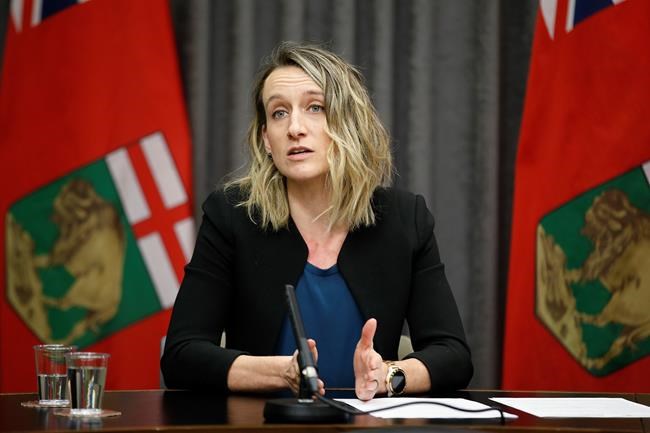
MIKAELA MACKENZIE / WINNIPEG FREE PRESS Dr. Joss Reimer, chief medical officer for the Winnipeg Regional Health Authority, has made it public she lives with depression and physical activity is one of the ways she stays healthy.
“I’ve been on medication for most of my adult life — not the entire time — and I haven’t been on the same medication,” the 40-year-old physician said.
“With different episodes I’ve had to go in and have things adjusted. Some people will be able to go on medication for a short time, but for others it is a chronic illness and you will be on it for the rest of your life, but that’s OK.
“Some people have to take medication for their diabetes or their high blood pressure, and some people take medication for their depression. Whatever keeps you healthy is the goal.”
“Some people have to take medication for their diabetes or their high blood pressure, and some people take medication for their depression. Whatever keeps you healthy is the goal.”–Dr. Joss Reimer
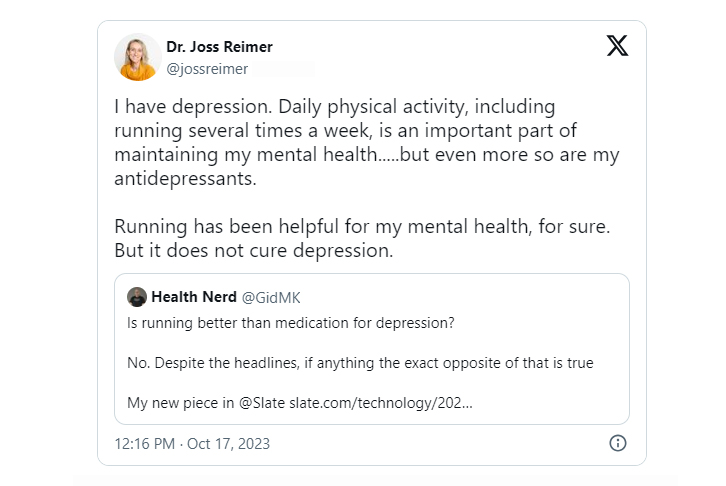
Last month, Reimer opened up about her condition after seeing a post on X (formerly Twitter) discussing the effectiveness of exercise in treating depression.
“Daily physical activity, including running several times a week, is an important part of maintaining my mental health, but even more so are my antidepressants,” she wrote.
“Running has been helpful for my mental health, for sure. But it does not cure depression.”
Reimer said this week she also went public to help reduce the stigma still faced by people with mental illnesses.
“I’ve been doing well for over 10 years with the right type of support, so I wanted people to see that,” she said.
“You can have a significant mental illness that would be debilitating at one point and you can still flourish in your personal life, your career — it is possible to achieve.
“You can even be a physician practising and the chief medical officer of an organization or even the president of the CMA (Canadian Medical Association) with depression.”
“You can have a significant mental illness that would be debilitating at one point and you can still flourish in your personal life, your career… it is possible to achieve.”–Dr. Joss Reimer
Marion Cooper, CEO of the Manitoba branch of the Canadian Mental Health Association, said while the stigma about mental illness is not what it was in the past, it is still there.
“We would like to see it that stigma doesn’t stop people from seeking help or support, but 40 per cent of people don’t seek help for anxiety and depression, so it is still there,” Cooper said.
“I want to thank Dr. Reimer for her courage and her vulnerability and to not underestimate the power of what she says is helping others.”
Cooper said her association was founded in 1918 by a doctor who publicly revealed his depression; Reimer is one voice in a chorus more than a century old of people using their lived experience to help others.
Depression ‘made everything feel difficult’
Medicine wasn’t Reimer’s first choice. The daughter of a rural family doctor, she was in the first year of studies for a degree in political science, headed for what she thought would be a career in international relations, when she fell into a depression.
“I just really struggled with being able to do the daily things which I needed to do,” she recalled. “The symptoms of depression vary from person to person, but for me it just really made everything feel difficult.
“Everything. Even small things. Doing grocery shopping, every errand, every task was too great and something I wasn’t capable of doing. That was what led me to go and meet with the doctor and talk about what I was experiencing and start on treatment towards getting back to a functional state.”
Reimer graduated, and then decided to change course and go into medicine. Depression followed her to medical school and again during her hospital residency.
“The most difficult (bout) I had was during residency,” she said. “That was the first time I actually really had to take a little bit of time away to step back and get healthy before I was able to go back.
“As a physician, when you’re needing to take care of other people, it’s really critical to be healthy yourself because you can’t effectively care for people when you’re not healthy.”
“As a physician, when you’re needing to take care of other people, it’s really critical to be healthy yourself because you can’t effectively care for people when you’re not healthy.”–Dr. Joss Reimer
Reimer recalls what her psychologist told her after hearing what she went through daily as a resident, including the long hours and little sleep.
“You don’t need counselling — you need a new job.”
Reimer became an obstetrician, but over time she realized she needed to do something else in the medical field to have more balance in her life.
While she still practises maternity care, she spent nine years as director of population health at the University of Manitoba’s medical school, developing the four-year course there before going into public health.
“In retrospect, I’m so glad I went through all that because I love public health,” she said.
“I love the work that I got to do throughout the pandemic and to be able to contribute to the community in the ways that I have.
“I also am glad I have gone through it because it helps me understand what other doctors are going through, struggling, or even my patients… it gives me the ability to empathize and find better ways to move forward.”
‘Very important topic’
Dr. Brent Roussin, the province’s chief public health officer, didn’t want to talk about Reimer’s openness directly, but said “it’s always commendable for people to show their strengths like that because you’re doing that to try and help other people.
“It’s a very important topic, it’s been an important topic all along, but the pressures that have been put on the health-care system — not only physicians but health-care workers — through the pandemic are real and coming out of it I think a lot of people are really reflecting on what they’ve gone through.”
Reimer said a combination of medication, exercise, supportive family and friends, enough sleep, and a better work-life balance has kept her healthy.
And that’s why she cycles, kayaks, plays volleyball and runs.
“I have a lot of people who think I’m crazy for the amount of physical activity I do,” Reimer said.
“For example, I run to work. A lot of people at work think that’s crazy. I use that term on purpose because, for me, maybe it is part of being crazy. Part of my mental illness.
“But it is the best crazy I can be.”
— With files from Danielle Da Silva
kevin.rollason@freepress.mb.ca

Kevin Rollason
Reporter
Kevin Rollason was a general assignment reporter at the Free Press.
Our newsroom depends on a growing audience of readers to power our journalism. If you are not a paid reader, please consider becoming a subscriber.
Our newsroom depends on its audience of readers to power our journalism. Thank you for your support.